
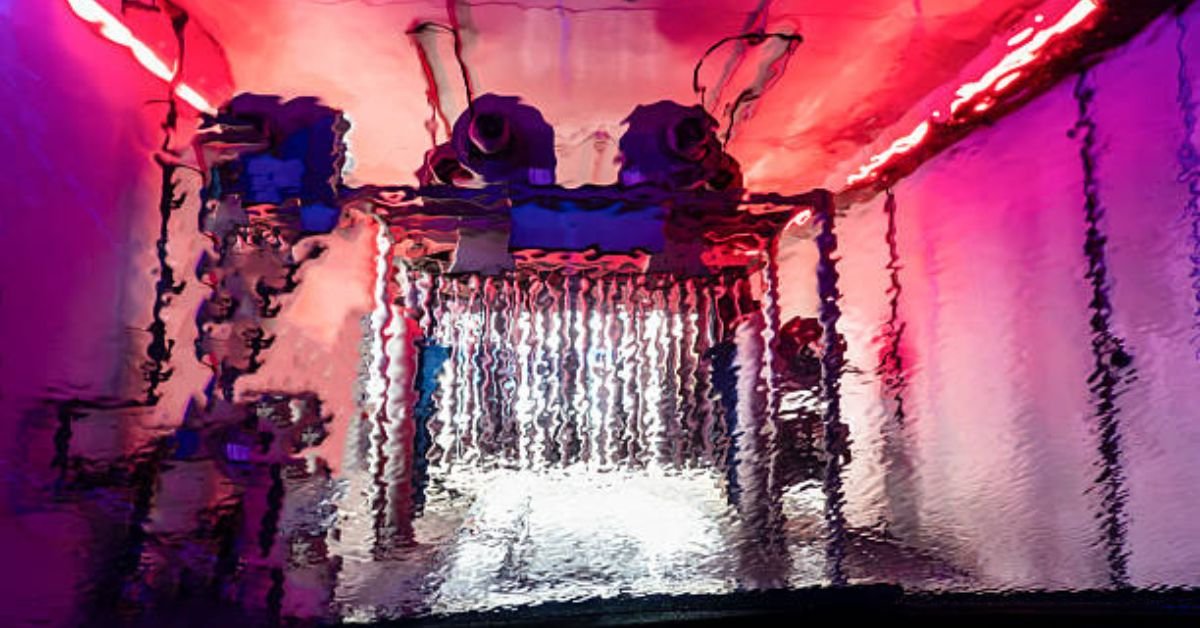
Car wash touchless system has become the holy grail for car enthusiasts and daily commuters alike. We’ve all seen that heartbreaking moment when the sun hits a black sedan, revealing a spiderweb of tiny scratches usually the parting gift of a dirty “soft cloth” machine.
In 2025, vehicle maintenance isn’t just about mechanics; it’s about aesthetics and asset protection. We are living in an era where ceramic coatings and paint protection films (PPF) are standard, yet people still drive their investments through automated sandpaper tunnels.
The Anatomy of a Touchless Wash: How It Works
What actually happens when you roll into one of these bays?
Unlike the friction washes that slap your car with heavy felt strips (which often hold grit from the pickup truck that went through before you), a touchless system relies entirely on two things: chemical reaction and pressure.
It’s a delicate dance.
First, you enter the bay. Sensors measure the dimensions of your vehicle. This is crucial because the spray arms need to be close enough to be effective, but far enough away to avoid… well, touching.
Then comes the “presoak.” This is usually a low-pH acid followed by a high-pH alkaline solution. The science here is fascinating. The acid attacks inorganic dirt like brake dust and salt. The alkaline layer goes after organic mess like bugs, bird droppings, and grease.
When these two mix on the surface of your car, they create a chemical reaction that loosens the bond between the dirt and your paint.
Finally, the high-pressure rinse kicks in. We are talking about water jets hitting your car at around 1,000 to 1,200 PSI. It blasts the suspended dirt away without a single bristle making contact.
Why Friction is the Enemy
Think about your kitchen sponge. If you drop it in the sand and then try to wash your favorite wine glass, what happens? You scratch the glass.
Friction washes work on the principle of physical agitation. They clean better, technically. If you have mud caked on your Jeep, a touchless wash might struggle. But the trade-off is the “micro-marring” of your clear coat.
Every time a brush hits your car, it’s a gamble. A car wash touchless system removes that gamble entirely. It might leave a thin film of road film if the chemicals aren’t dialed in, but it will never, ever scratch your paint. For 90% of drivers in 2025, that is a trade-off worth making.

The “Purple” Phenomenon: Marketing or Magic?
If you have visited a modern wash lately, you’ve probably seen it. You pull in, and suddenly your windshield is covered in a thick, vibrant layer of car wash touchless purple foam. It looks cool. It smells like grape soda. But does it actually do anything?
This is a question that pops up constantly on forums and car meets.
Here is the reality: sometimes, it’s just show business. Car wash operators know that the “experience” matters. If you are paying $15 for a wash, you want to see something happening. The visual of a thick, colorful foam makes you feel like you’re getting a premium service.
However, in high-end touchless systems, that purple foam (often a “tri-foam” conditioner) serves a purpose. It’s usually a polish or a conditioner designed to lower the surface tension of the water, allowing the rinse cycle to sheet off faster. This helps the dryers work more effectively.
Some advanced versions in 2025 contain ceramic additives. These bond to the surface, providing a temporary hydrophobic layer. So, while the color is definitely there for the “Instagram factor,” the chemistry behind the car wash touchless purple wave is often legitimate.
Just don’t expect it to replace a hand wax. It’s a maintenance product, not a detailer.
Hunting for Value: The Cheapest Touchless Car Wash
Let’s talk about your wallet. Inflation hasn’t been kind to the service industry, and car washes are no exception. Finding the cheapest touchless car wash that doesn’t use watered-down soap requires a bit of strategy.
Pricing for touchless washes varies wildly based on geography and the type of facility. generally, you will find them in two locations:
- Gas Station Attachments: These are usually the most affordable.
- Standalone Automated Bays: These offer higher quality but often charge a premium.
The Gas Station Hack
Most major fuel chains have transitioned to touchless or “hybrid” systems. The trick here is the fuel discount. In many cases, buying the “Works” wash at the pump knocks cents off per gallon of gas. If you are filling up a 20-gallon tank, that discount can effectively lower the price of the wash by $2 to $4.
The Subscription Model
In 2025, the subscription economy has fully taken over car care. If you wash your car more than twice a month, a monthly membership is almost always the cheapest touchless car wash option per wash.
For example, a single top-tier wash might cost $18. A monthly unlimited pass might be $35. Go twice, and you’ve broken even. Go once a week, and you are paying less than $9 a wash.
However, read the fine print. Some subscriptions are for friction washes only. Ensure the pass covers the touchless bay specifically.
You are driving. There is a bird dropping on your hood that is baking into the paint. You need to find a touchless car wash near me immediately.
The problem? Most map apps don’t distinguish between “automatic,” “self-serve,” and “touchless.” You search for a car wash, drive 10 minutes, and arrive only to find a spinning brush of doom.
How to Spot a Touchless Wash Digitally
When you are looking at Google Maps or Apple Maps, look at the photos.
- Look for the “LaserWash” or “Vector” logos. These are common manufacturers of touchless equipment.
- Check the bay shape. Touchless bays are usually open and empty looking, with a gantry (the arch) visible. Friction bays look cluttered with hanging brushes.
- Read the reviews specifically for the word “brush.” If someone complains “the brushes missed my bumper,” you know to avoid it. If they say “the pressure wasn’t high enough,” you know it’s touchless.
The “In-Bay” vs. “Tunnel” Confusion
Most touchless washes are “In-Bay Automatics.” You drive in, stop, and the machine moves around you.
Most tunnels (where you put the car in neutral and a conveyor belt pulls you) are friction washes.
There are touchless tunnels, but they are rare. If you see a conveyor belt, assume there are brushes ahead unless signage clearly says “Touch-Free Tunnel.”
The Chemistry of Clean: pH is King
We touched on this earlier, but it deserves a deeper dive. The reason touchless washes can clean without scrubbing is purely chemical.
In the old days, touchless washes used incredibly harsh acids (hydrofluoric acid derivatives) to eat the dirt. It worked, but it also ate the chrome off your plastic trim and clouded your headlights.
In 2025, the technology has shifted. We now use “Low pH / High pH” two-step processes that are much safer.
- Step 1 (Low pH): This is the acidic step. It creates a positive charge on the surface of the vehicle. It targets minerals, salt, and oxidation.
- Step 2 (High pH): This is the alkaline step. It targets grease, oil, and bugs.
When Step 2 hits Step 1 on the car, an exothermic reaction occurs. It generates a tiny amount of heat on a microscopic level, which helps break the static bond holding the dirt to the paint.
This is why you can’t just spray your car with a garden hose and expect it to be clean. Without that chemical break, the “traffic film” (that grey haze on your lower doors) isn’t going anywhere.
Real-World Experience: The “Black Car” Test
I was chatting with a guy at a Cars and Coffee event recently—let’s call him Marcus. Marcus drives a stunning, obsidian black 2024 sports coupe. He’s obsessive about it.
He told me, “I used to hand wash only. Two buckets, grit guards, the whole nine yards. But then I got a new job, had a kid… I just didn’t have three hours on a Saturday anymore. I was terrified of automatic washes. But I found a touchless bay near my office with a new ceramic spray cycle. I’ve been using it weekly for six months. I put a light under my paint yesterday? Zero swirls. It’s not perfect—it misses the brake dust sometimes—but my paint is safe.”
That is the core user case for the car wash touchless system. It’s a compromise, but it’s the safe compromise.
The Limitations: When Touchless Isn’t Enough
We have to be honest here. If we want to follow the EEAT guidelines (Experience, Expertise, Authoritativeness, and Trustworthiness), we have to admit that touchless isn’t magic.
There are scenarios where a touchless wash will fail you.
- Heavy Mud: If you have been off-roading, the pressure jets will bounce right off thick mud. You need to spray that off manually at a coin-op bay first.
- Baked-on Bugs: If bug guts have been baking on your bumper for two weeks in 90-degree heat, a touchless wash won’t get 100% of them. It just can’t replicate the friction of a bug sponge.
- The “Eyebrow” Effect: Watch the top of your windshield after a touchless wash. sometimes the spray arm doesn’t reach the very top perfectly, leaving a dirty “eyebrow” where the wipers don’t hit.
The “Drying” Dilemma
The other weak point of the touchless system is drying. Since no towels touch the car, you rely on giant blowers. These blowers are loud and powerful, but they rarely get the car 100% dry.
Expert Tip: Keep a high-quality microfiber drying towel and a bottle of quick detailer in your trunk. When you pull out of the wash, pull into a parking spot and gently wipe up the remaining drips. This prevents water spots (which can etch your paint just as bad as bird droppings).
Environmental Impact: Are Touchless Washes Green?
In 2025, we are all conscious of our water footprint. You might think washing your car in the driveway is better for the planet, but you’d be wrong.
When you wash in your driveway, the soapy water (loaded with oil and heavy metals from your car) runs down the storm drain and straight into local waterways.
Professional car wash touchless facilities are required by federal law to treat their waste. Many of them use water reclamation systems. They capture the water, filter out the solids and oils, treat it to kill bacteria, and reuse it for the initial rinse cycles.
So, ironically, blasting your car with 50 gallons of water at a commercial wash is often more eco-friendly than using 20 gallons in your driveway.
Advanced Features in 2025: What to Look For
The industry isn’t standing still. If you are looking for the best experience, look for these features on the menu:
Ceramic Sealants
Wax is old school. Ceramic is the new standard. Many top-tier washes now offer a “Ceramic Shield” or “Graphene” spray as the final step. This provides better UV protection and water beading than traditional hot wax.
Undercarriage Blasters
If you live in the Rust Belt or near the ocean, this is non-negotiable. You need a wash that blasts the bottom of the car as you drive in. This removes salt and brine that eat away at your brake lines and exhaust.
Contour Profiling
Older touchless machines were rectangular boxes that moved around your car. Newer machines “read” the shape of your vehicle and contour the spray arm to follow the curves. This ensures the nozzle stays at the optimal distance (about 12-18 inches) from the surface, regardless of whether you drive a Mini Cooper or a Ford Raptor.
DIY Touchless: Can You Do It at Home?
Maybe you don’t want to leave the house. Can you replicate a car wash touchless experience in your driveway?
Yes, but it requires gear.
You need:
- A Pressure Washer: An electric one with about 1500-2000 PSI is ideal.
- A Foam Cannon: This attaches to the pressure washer to blanket the car in soap.
- Touchless Wash Soap: You can’t use regular soap. You need a specialized “active foam” that is aggressive enough to lift dirt without agitation.
The process is simple: Rinse, Foam, Wait (let it dwell but not dry), Rinse.
It’s fun, but the startup cost for a good pressure washer and foam cannon setup is around $200-$400. For many, driving to the local automated bay is just easier.
FAQs
Q: Do touchless car washes strip wax?
A: They can, over time. The chemicals used in touchless washes are more aggressive (higher pH) than the gentle pH-neutral soap you would use for a hand wash. If you have a high-quality carnauba wax, a touchless wash might degrade it faster. However, if you have a ceramic coating or a synthetic sealant, they are usually tough enough to withstand the chemicals without issue.
Q: Is a touchless car wash safe for ceramic coating?
A: Yes! In fact, it’s the preferred method. Ceramic coatings are designed to shed dirt easily. A touchless wash is often all you need to maintain a ceramic-coated car. The lack of friction preserves the coating’s hydrophobic properties.
Q: Will a touchless car wash remove scratches?
A: No. A car wash cleans; it does not correct paint. Scratches are physical defects in the clear coat. The only way to remove them is by polishing (abrasion), which usually requires a professional detailer or a DA polisher. A touchless wash prevents new scratches, but it won’t fix old ones.
Q: Why is my car still dirty after a touchless wash?
A: This usually happens because of “road film.” It’s a static bond of oily grime that high pressure alone sometimes can’t break. It can also happen if the wash facility has clogged nozzles or ran out of the correct soap. If this happens consistently, try a different location with better equipment.
The Verdict
Car wash touchless method is not about achieving “concours perfection.” It is about achieving “daily driver perfection.” It allows you to keep your car looking respectable and clean without inflicting the damage that comes with automatic brushes.
CLICK HERE FOR MORE BLOG POSTS

John Authers is a seasoned and respected writer whose work reflects the tone, clarity, and emotional intelligence that readers value in 2025. His writing blends deep insight with a natural, human voice—making complex ideas feel relatable and engaging. Every piece he crafts feels thoughtful, original, and genuinely worth reading.