
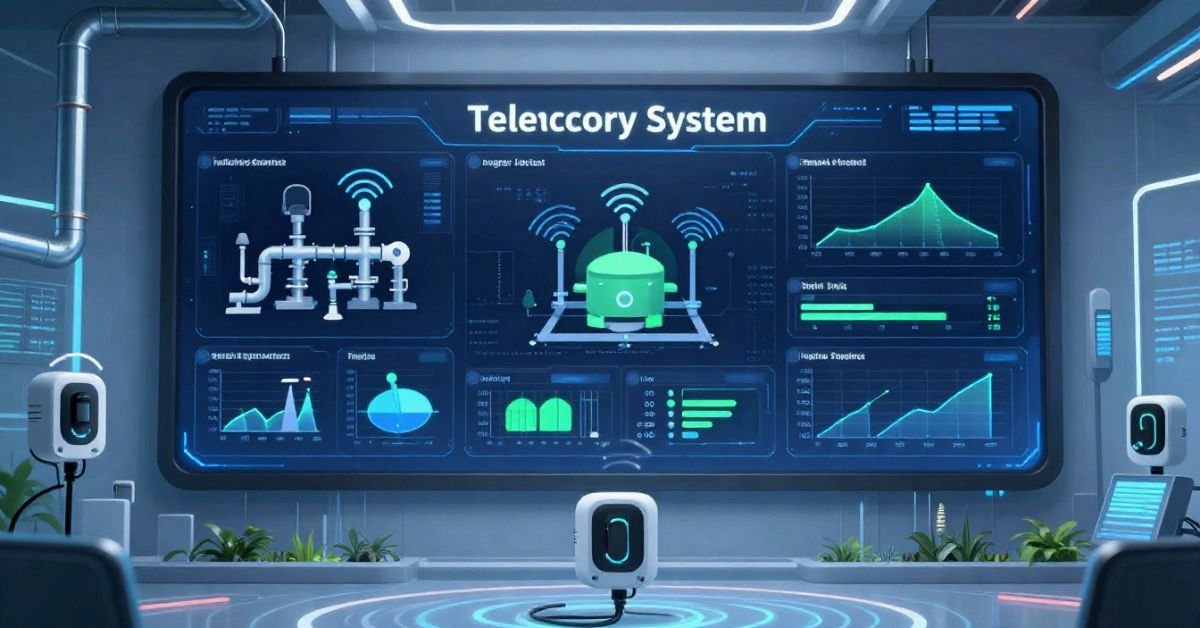
Telemetry comes from Greek: tele (far) and metron (measure). It refers to the field of knowledge focused on remotely measuring physical quantities and automatically transmitting the results of those measurements to a receiving station.
A telemetry system, on the other hand, is the practical device or complete technological solution that performs this function.
It is important to distinguish between the two terms:
- Telemetry the scientific concept or discipline
- Telemetry system the actual product or technology used in practice
People searching for a “telemetry system” or “telemetry module” usually have a specific goal: implementing remote monitoring in a facility, industrial plant, or machine network.
How Does a Typical Telemetry System Work?
Regardless of the industry, every telemetry system follows the same four-step process:
Measurement
A sensor or meter records the physical parameter of interest (current, flow, pressure, temperature, or position).
Conversion
A measurement converter (voltage, current, or frequency type) converts the physical signal into a format readable by electronic systems.
Transmission
The telemetry module sends the data through a communication medium such as GSM, LoRa, Wi-Fi, or the Internet to a monitoring station.
Analysis and Action
A control center, SCADA system, or cloud platform receives the data, visualizes it, generates alarms, and enables remote control.
Where Are Telemetry Systems Used?
Industry and Critical Infrastructure
This is the most developed application area for telemetry. Telemetry systems allow continuous monitoring of sewage pumping stations, water treatment plants, gas pipelines, and heating networks.
Remote meter readings for electricity, water, and gas eliminate costly manual inspections and reduce reading errors. If a problem occurs for example, a tank level exceeding its limit or a drop in pipeline pressure the system automatically generates an alarm and notifies the service team.
Precision Agriculture and Environmental Monitoring
Modern farms use telemetry to monitor soil moisture, air temperature, and water levels in reservoirs.
Telemetry systems installed at weather stations send real-time data to irrigation or spraying management systems. In environmental protection, telemetry helps monitor water quality, seismic activity, and volcanic activity often in remote areas with limited power and internet access.
Transport and Logistics
Telemetry systems are the foundation of fleet management.
A GPS telemetry module installed in a truck can transmit information about location, driving style, fuel consumption, and the vehicle’s technical condition.
The result:
- optimized routes
- reduced fuel costs
- better customer service through accurate delivery forecasts
In refrigerated transport, telemetry monitors cargo temperature to ensure compliance with food safety standards.
Building Automation (BMS) and Vending
Building Management Systems (BMS) rely on telemetry for remote control of heating, ventilation, and air conditioning (HVAC).
Vending machine operators also use telemetry to monitor inventory remotely. They know which products are running out and which machines require service, allowing them to restock efficiently and increase sales.
Scientific Research and Surveys
From volcano monitoring and satellite climate research to TV audience measurement, telemetry is essential wherever data must be collected automatically from many distributed sources.
For example, TV audience measurement devices record viewer activity and send the data to a central database for analysis.
Technologies Used in Telemetry Systems
Choosing the right communication technology is one of the most important elements of designing a telemetry system. Each option has advantages and limitations.
Wired Communication
Copper cables, fiber optics, and Ethernet provide the highest reliability and security.
They are ideal for industrial facilities where electromagnetic interference could disrupt wireless communication.
Disadvantage:
High installation cost and difficulty of laying cables across large areas.
Short-Range Wireless Communication
Technologies such as:
- Wi-Fi
- Bluetooth
- ZigBee
work well inside buildings and small areas. They offer high bandwidth but require continuous power and have limited range.
Cellular M2M Communication (GSM / LTE / 5G)
Cellular networks are one of the most common communication methods for field telemetry systems.
M2M SIM cards allow data transmission from almost any location.
Older GSM/GPRS networks are gradually being replaced by LTE and 5G, which offer higher speeds and lower latency.
Considerations:
- subscription costs
- potential signal issues in remote areas
LPWAN Networks: LoRa, NB-IoT, and Sigfox
These technologies represent a major innovation in telemetry.
LPWAN (Low Power Wide Area Network) combines long range with extremely low power consumption.
A LoRa telemetry module can run on a battery for several years.
Typical applications include:
- water meters
- soil sensors
- river level monitoring
- environmental sensors

Main LPWAN technologies:
LoRaWAN
Open standard with the ability to build private infrastructure, widely used in Smart City projects.
NB-IoT
Based on cellular infrastructure and commercially available through telecom operators.
Sigfox
A global proprietary network designed for very small data transmissions.
Hybrid Systems and Redundancy
Critical infrastructure often uses redundant communication systems.
For example:
- primary connection: Ethernet
- backup connection: GSM
If one network fails, the system automatically switches to the alternative channel, ensuring uninterrupted monitoring.
Types and Parameters of Telemetry Devices
Device Categories
Telemetry hardware comes in several forms depending on its function:
Data loggers
Collect and store measurement data locally for later retrieval or online transmission.
Telemetry modules / RTU (Remote Terminal Unit)
Devices that read sensor signals and enable remote control of outputs such as pumps or valves.
IoT gateways
Aggregate data from multiple modules and send it to the cloud.
Data concentrators
Combine signals from different sources into a single interface for supervisory systems.
Key Technical Parameters to Consider
When choosing a telemetry module, consider the following:
- Number of I/O channels how many sensors or control outputs are required
- Input types analog (4 20 mA, 00 V), digital, or pulse inputs
- Communication interfaces RS-485 / Modbus RTU, MQTT, Modbus TCP
- Protection rating IP65 or IP67 for outdoor devices
- Operating temperature range typically −40°C to +70°C
- Power supply 230 V AC, 12/24 V DC, or battery power
- Internal memory for buffering data during communication interruptions
Telemetry System vs SCADA What Is the Difference?
This question is common among people new to automation.
The difference is simple: they operate at different levels of the data chain.
Telemetry system
Responsible for collecting data in the field and transmitting it.
SCADA (Supervisory Control and Data Acquisition)
Software that receives the data, visualizes it, archives it, and allows operators to control devices remotely.
In simpler systems, telemetry modules may send data directly to cloud platforms or web applications without a full SCADA implementation.
How to Choose the Right Telemetry System Step-by-Step Guide
Define Your Goals
Determine what you want to measure and how often you need the data.
Ask yourself:
- What parameters should be monitored?
- How frequently should measurements be taken?
- Do you need remote control functionality?
Evaluate Field Conditions
Check:
- cellular network coverage
- whether the device will be installed indoors or outdoors
- available power supply
These factors influence the required protection level and communication technology.
Analyze Total Cost of Ownership (TCO)
The price of the telemetry module is only part of the cost.
You should also consider:
- SIM card and data transmission fees
- visualization platform subscription
- installation costs
- integration with existing systems
A well-implemented system usually pays for itself quickly through operational savings and improved efficiency.
Choose the Right Communication Technology
A simple rule:
- If power supply is available and high bandwidth is required → LTE or Ethernet
- If the device must run on battery for years → LoRaWAN or NB-IoT

Frequently Asked Questions (FAQ)
What is a telemetry system?
A telemetry system is a technological solution that automatically collects measurement data from remote locations and transmits it to a monitoring station using communication networks such as cellular networks, the Internet, or radio.
What is the difference between telemetry and remote control?
Telemetry focuses on transmitting measurement data from the field to the control center. Remote control allows commands to be sent in the opposite direction.
Modern telemetry systems usually combine both capabilities.
Does a telemetry system require the Internet?
Not always. Simple radio telemetry systems can transmit data directly to a receiving station without internet connectivity.
However, internet connectivity is needed when data must be available online or stored in cloud platforms.
What is the range of a LoRa telemetry system?
In open areas, LoRa modules can achieve a range of 10 15 km or more with proper antenna placement.
In cities, typical range is 2 5 km.
Can telemetry systems run on batteries?
Yes. Low-power technologies such as LoRaWAN and NB-IoT allow telemetry modules to operate for several years on a single battery, depending on transmission frequency.
What is the Modbus protocol and why is it important?
Modbus is one of the most widely used communication protocols in industrial automation.
Common versions include:
- Modbus RTU (via RS-485)
- Modbus TCP (via Ethernet)
Many sensors, energy meters, and industrial controllers support Modbus, making it easy to integrate them with telemetry systems.
Are telemetry systems secure?
Modern telemetry systems use advanced security mechanisms such as:
- encrypted communication (TLS/SSL)
- device authentication
- network segmentation
These measures are particularly important for critical infrastructure systems.
Conclusion
Telemetry systems deliver significant operational benefits:
- reduced maintenance and service costs
- faster response to failures through automated alerts
- process optimization based on real-time and historical data
- compliance with regulatory requirements in industries such as energy and water management
Whether you manage a water network, a vehicle fleet, a farm, or an industrial facility, there is a telemetry solution tailored to your needs.
The key is properly defining your requirements and choosing a partner experienced in designing and implementing telemetry systems.
Contact our team to find the optimal solution and guide you through the entire telemetry system implementation process.
CLICK HERE FOR MORE BLOG POSTS

John Authers is a seasoned and respected writer whose work reflects the tone, clarity, and emotional intelligence that readers value in 2025. His writing blends deep insight with a natural, human voice—making complex ideas feel relatable and engaging. Every piece he crafts feels thoughtful, original, and genuinely worth reading.